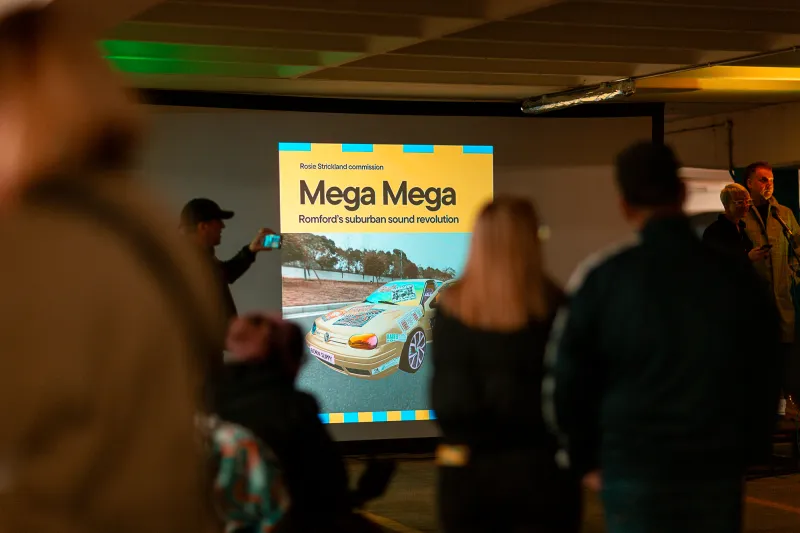
Mega Mega: Romford’s Suburban Sound Revolution
Culture Does Not Just Happen in Cities
When cultural history is written, there is a tendency to locate every significant scene, movement or breakthrough within the boundaries of a recognised city. London, Manchester, Berlin and New York become convenient reference points, absorbing the stories that developed around them and reducing the places beyond their centres to supporting roles. It is an efficient way of explaining culture, but often a misleading one. Many of the most important movements in music, fashion and nightlife were shaped in suburbs, market towns, industrial communities and outer boroughs, where local networks were able to develop their own language before the wider world understood what was happening.
Romford is one of those places.
Opening in October 2026, Mega Mega: Romford’s Suburban Sound Revolution will examine the Essex town’s role in the development of British electronic music between 1989 and 1999.
Through archive material, oral histories and new commissions, the exhibition will tell a national story from a local perspective, tracing how record shops, pirate radio stations, labels, promoters, producers and dancers helped create a cultural ecosystem whose influence travelled far beyond Havering.
The story is closely connected to the rise of hardcore, jungle, drum and bass and garage, but the exhibition is concerned with more than genre. It asks us to reconsider how cultural movements are formed, how they spread and why some places are remembered while others disappear from the record. Romford was not simply a satellite of London. It had its own infrastructure, its own audiences and its own way of circulating music. Shops such as Boogie Times and labels including Suburban Base did not merely respond to a movement taking place elsewhere. They helped shape it.
Before the internet made every new sound instantly available, culture moved through people. Records changed hands in shops and bedrooms. Flyers passed through schools, town centres and youth clubs. Pirate radio carried unfamiliar music across housing estates. Information travelled through phone lines, conversations and word of mouth. To experience something new, you often had to seek it out physically, travelling to a particular shop, club or town because that was where the energy was forming.
That distance mattered. It created anticipation and allowed scenes to develop a distinct identity before they were absorbed into a broader narrative. A sound could belong to a place because the people making it, selling it, broadcasting it and dancing to it were connected by geography as much as taste. Local culture was not a smaller version of metropolitan culture. It was often the point from which new ideas entered the mainstream.
Cultural history is never preserved automatically. It depends on what survives and who is given the authority to interpret it. A cassette in a drawer, a photograph in a loft, a flyer without a date or a memory shared between friends can carry as much historical value as an official archive, yet much of this material remains vulnerable because it sits outside institutions. Once those objects are lost, or the people connected to them are no longer able to explain their meaning, significant parts of the story disappear.
The exhibition is inviting DJs, MCs, radio broadcasters, promoters, record shop workers and dancers to contribute objects and memories. This approach recognises that the people who participated in the scene were not merely an audience. They were part of the cultural machinery that gave it momentum. The atmosphere of a record shop, the reach of a pirate signal, the design of a flyer or the collective identity of a dancefloor all shaped how the music was understood.
This also raises a wider question about authorship. Culture is often remembered through the people who later became visible, successful or institutionally recognised. Collective movements become simplified into stories about a small number of names. Towns and communities that created the conditions for those movements to grow become footnotes, while the cultural centre claims ownership of what emerged around it.
Mega Mega offers a different model. By building the exhibition around local testimony and personal archive, it places value on lived experience and allows the community to take part in defining its own history. It treats memory not as an anecdotal supplement to the official story, but as one of its most important sources.
There is urgency in this work. The generation that experienced the first wave of British rave culture is getting older. Venues have closed. Record shops have disappeared. Pirate broadcasts were rarely preserved. Much of the remaining evidence exists in private collections, domestic spaces and personal recollection. Search engines and streaming platforms may provide access to the music, but they cannot fully reconstruct the social conditions that produced it.
Mega Mega opens in Romford from October to December 2026, but the significance of the project reaches beyond one town and one decade. It is a reminder that culture does not only happen where media, funding and institutions are already concentrated. It happens wherever people create their own spaces, build local networks and generate enough energy for others to travel towards them.